
1
The landscape we see today began with sand that settled at the bottom of a body of water that no longer exists.
A full Part 3 task turned into a lesson. Learn the method, warm up with the key words, solve 9 questions, then see exactly which trap each wrong paragraph sets for you.
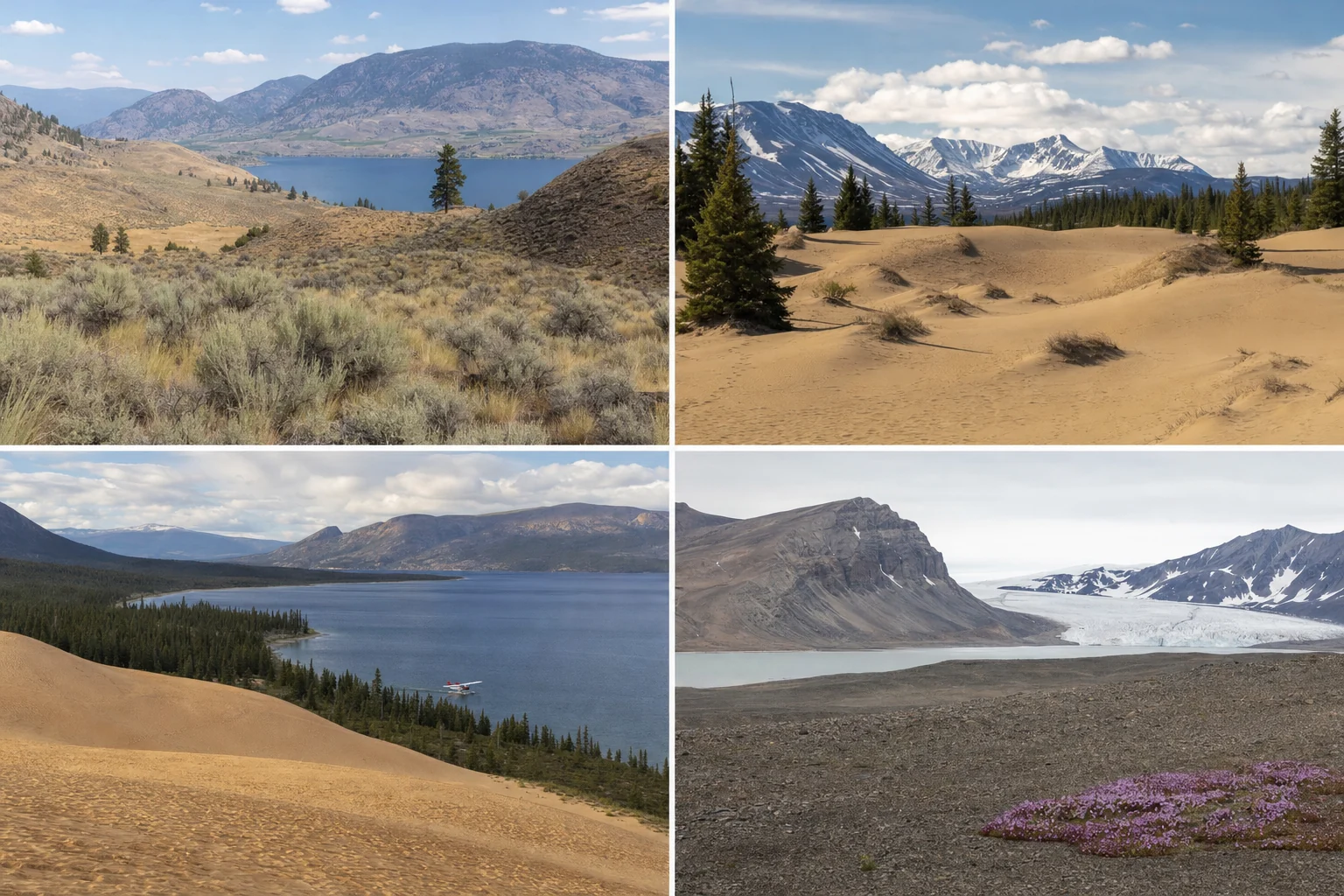
Each statement matches one paragraph (A to D). Choose E only when the information is not given anywhere. A paragraph can be the answer more than once.
Every question has one paragraph that looks right but isn't. Most mistakes in Part 3 come from these five tricks, so get to know them now and you'll spot them much faster.
27 words that carry the answers. Translate them into your language, then test yourself.
Every word from the passage with meaning, synonym and translation, plus the paraphrases that lead to each answer.
Lesson mode: you see the answer and the trap right after each choice.
Most people picture Canada as a land of forests, lakes and long winters, so it often surprises visitors to learn that parts of the country look remarkably like a desert. A well-known example lies near the town of Osoyoos in the southern interior of British Columbia. The valley sits in the rain shadow of the Cascade Mountains, which capture much of the moisture carried by Pacific air before it can reach the area. Consequently, summers are long, hot and dry, and annual rainfall is low. The resulting shrub-steppe ecosystem is dominated by sagebrush, antelope-brush and native bunchgrasses. Although the land may look empty, it shelters a surprising number of species, several of which are considered at risk. Vineyards, orchards and new housing have steadily replaced much of the original habitat, which has led conservation groups to call for stronger protection of what remains.
Far to the north, the Carcross Desert in Yukon offers a very different scene. In spite of its name, scientists do not classify it as a true desert, since the area receives too much precipitation. Its sand was laid down roughly 10,000 years ago on the floor of a large glacial lake. When the ice melted and the lake drained, strong winds began moving the exposed sand, building dunes that are still slowly changing shape today. These conditions support a small community of plants and insects, some of which are rarely seen anywhere else in the region. Visitors are welcome to explore the dunes, but they are asked to stay on marked trails so that fragile plants are not trampled.
An even larger sandy landscape stretches along the southern shore of Lake Athabasca in northern Saskatchewan. The Athabasca Sand Dunes extend for about 100 kilometres, forming the largest area of active sand in Canada, and some dunes rise as high as 30 metres. Unlike the hot deserts people usually link with sand, this area is surrounded by boreal forest and receives enough moisture that it cannot be called a climatic desert. Because the area is so remote, it has kept unusual landforms and a number of plants that grow nowhere else on Earth. To protect these delicate habitats, the provincial park is divided into separate management zones. Getting there is a challenge: there are no roads, so visitors must arrive by float plane and bring everything they need, as the park offers no services.
Not every desert is hot or sandy. In Canada's High Arctic, precipitation is so low that much of the region is classified as polar desert. Quttinirpaaq National Park, on the northern tip of Ellesmere Island in Nunavut, is a striking example. Winters there are long and bitterly cold, summers are brief, and the amount of daylight swings from months of darkness to months of constant sun. Across most of the park, the combination of dryness and cold keeps plant life extremely sparse. Around Lake Hazen, however, slightly warmer and more sheltered conditions allow grasses, Arctic wildflowers and grazing animals to flourish during the short growing season. This contrast shows that even in a polar desert, small differences in local conditions can decide where living things are able to survive.
The landscape we see today began with sand that settled at the bottom of a body of water that no longer exists.
This place has the country's most extensive area of moving sand.
Nearby high ground plays a part in keeping this area dry.
Unlock the full lesson: every question with its trap, a timed exam mode and your personal trap report.